06 October 2026
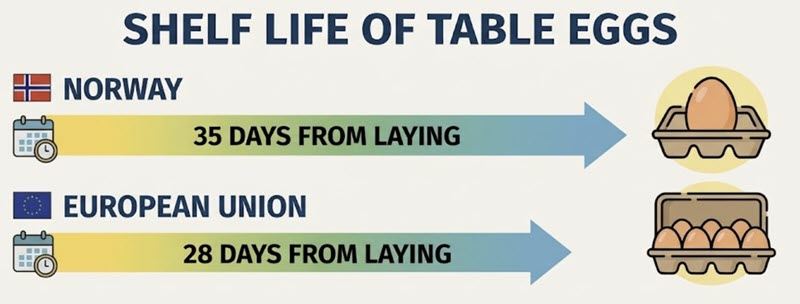
A comprehensive scientific assessment published by the Norwegian Scientific Committee for Food and Environment (VKM) concludes that table eggs produced in Norway remain safe for consumption for at least 35 days, providing scientific backing for Norway to retain its extended shelf-life standards despite European Union restrictions.
The evaluation was requested by the Norwegian Food Safety Authority (Mattilsynet) following EU regulatory amendments mandating a strict 28-day best-before limit across the EEA. Under previous national practice, Norwegian producers applied a 35-day shelf life, supported by national cold-chain mandates and rigorous disease control.
According to the VKM Panel on Biological Hazards, the scientific premise underpinning the European Food Safety Authority’s (EFSA) 2014 guidance - which forms the foundation of the EU's 28-day cap - does not apply to Norwegian production. The EFSA model relies heavily on the risks associated with Salmonella Enteritidis and its capacity for vertical transmission into the egg yolk prior to laying. In contrast, systematic surveillance programs in Norway demonstrate a near-total absence of Salmonella in commercial laying flocks, effectively ruling out vertical transmission.
Norwegian regulations enforce continuous chilled storage at or below 12°C throughout transport, storage, and retail.
The committee concluded that as long as the refrigerated supply chain is maintained, raw, non-heat-treated eggs produced in Norway pose no health risk within 35 days of laying, justifying a national exemption from the 28-day EU limit.
VKM Report 2026:01, Shelf-Life and Food Safety of Eggs in Norway