20 December 2025
The U.S. Poultry & Egg Association (USPOULTRY), in collaboration with the FDA and Mindwalk Consulting Group, has released its latest report quantifying antibiotic usage trends in the U.S. poultry industry over the past decade. The 2024 data reveals a sustained commitment to the reduction of medically important antimicrobials, particularly in hatcheries, while identifying specific disease pressures, such as avian metapneumovirus (aMPV) and gangrenous dermatitis, that have necessitated targeted therapeutic interventions in recent years.
The report aggregates voluntary data covering the period from 2013 to 2024 for broilers and turkeys, and 2016 to 2024 for layers. The dataset represents a substantial portion of U.S. production:
- Broilers: >87% of annual production (>8 billion chickens).
- Turkeys: >72% of annual production (~143 million turkeys).
- Layers: ~45% of annual production (~140 million hens).
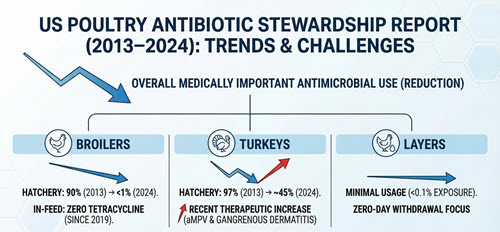
Broiler Chickens: The broiler sector has seen drastic reductions in routine antibiotic administration. The percentage of broiler chickens receiving antibiotics in the hatchery plummeted from 90% in 2013 to less than 1% in 2024.
regarding in-feed applications:
- Tetracycline: Zero reported usage since 2019.
- Virginiamycin: Usage decreased by over 99% across the 12-year period.
However, water-soluble applications reflect the industry's response to clinical realities. While penicillin and lincomycin usage dropped significantly between 2013 and 2019, both saw upticks (27% and 15% respectively) from 2020–2024 due to increased incidence of gangrenous dermatitis. Furthermore, tetracycline use increased substantially post-2023 to control secondary bacterial infections following outbreaks of avian metapneumovirus (aMPV).
Turkeys: Similar to broilers, the turkey sector reduced hatchery antibiotic administration from 97% in 2013 to approximately 45% in 2024.
In-feed tetracycline usage saw a 77% decline from 2013 to 2022 but has increased more than three-fold since 2022. This sharp increase is attributed largely to the control of secondary bacterial infections precipitated by aMPV infections. Additionally, water-soluble lincomycin usage increased more than six-fold from 2019-2024 due to gangrenous dermatitis challenges and penicillin shortages.
Layer Hens: Antibiotic usage in table egg production remains distinct from meat bird production due to withdrawal periods that prevent eggs from entering the food supply. Consequently, less than 0.1% of total hen-days were exposed to Chlortetracycline (CTC), the primary medically important antibiotic used in this sector. CTC is favored because it has a zero-day withdrawal period.