09 December 2025
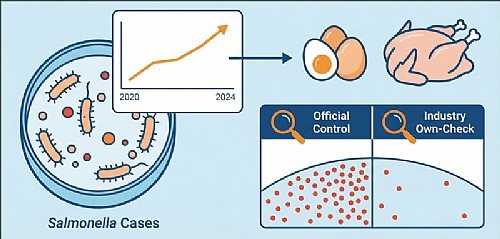
The latest European Union One Health Zoonoses Report identifies Salmonellosis as the second most common zoonosis in humans and the leading cause of food-borne outbreaks. According to the 2024 report recently released by the European Food Safety Authority (EFSA) and the European Centre for Disease Prevention and Control (ECDC), Salmonella infections continue to pose a significant public health burden, with a statistically significant increasing trend observed over the period of 2020–2024.
In 2024, 79,703 confirmed human cases of salmonellosis were reported, corresponding to a notification rate of 18.6 cases per 100,000 population, a 1.7% increase compared to 2023. Salmonella remained the most frequent causative agent in food-borne outbreaks, resulting in 1,823 hospitalizations and 17 deaths.
The top five serovars acquired within the EU were:
- S. Enteritidis (58.4%)
- S. Typhimurium (11.0%)
- Monophasic S. Typhimurium (10.4%)
- S. Infantis (3.2%)
- S. Derby (1.2%)
Eggs and egg products remain the source of most concern in outbreaks.
A significant divergence was observed between results from samples collected by Competent Authorities (official control) versus those collected by Food Business Operators (own-checks) on carcases at slaughterhouses:
Broilers: 18.7% positive in official samples vs. 4.9% in operator own-checks.
Turkeys: 17.4% positive in official samples vs. 3.5% in operator own-checks