Skrzypczyk & Wasley (2026, March 31). The Bureau of Investigative Journalism
31 March 2026
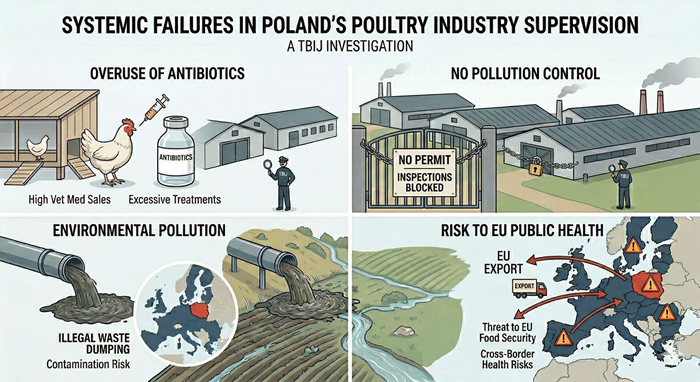
A major investigation by the Bureau of Investigative Journalism (TBIJ) has exposed significant regulatory failings in Poland's massive poultry industry, with nearly 1,000 large-scale farms potentially operating without necessary environmental permits and facing inadequate veterinary inspections. This situation, in the European Union's largest poultry producing country, creates a significant risk for undetected disease outbreaks and severe environmental pollution.
The investigation revealed that almost half of Poland’s approximately 2,000 industrial-scale poultry farms, lack required "integrated permits" related to pollution control, a clear breach of EU law. These farms fly under the radar of environmental inspectors, who only monitor registered facilities. The discrepancies are vast: while veterinary records in the poultry-dense Mazowieckie region suggest over 600 megafarms exist, the climate ministry's data only accounts for 261. This lack of centralized data and fragmented responsibility among regional authorities allows hundreds of farms to operate with minimal environmental scrutiny.
TBIJ's investigation, which co-published its stories with global media outlets including in the UK, found alarming conditions on some farms. In one instance near Czepielin, a turkey farm permitted for 70,000 birds was found to house up to 120,000. Such significant overcrowding facilitates the rapid spread of disease, which farmers often counter with high volumes of antibiotics. According to calculations based on European Medicines Agency data, Poland ranks second in the EU for veterinary antibiotic sales, with the average meat bird receiving 3 to 4 courses of treatment during its short six-week life. This excessive use significantly accelerates the rise of drug-resistant bacteria.
Recent EU audits have also flagged major failures in Poland's salmonella monitoring and control. The data suggests that official figures for salmonella detection are several times higher than the "self-monitoring" data provided by food producers, suggesting that the true extent of contamination is likely being underreported.
Between 2021 and 2023, Poland recorded 193 bird flu outbreaks, with one instance where four tonnes of infected turkey meat was exported before detection. The lack of resources further exacerbates the problem, with reports of inspectors facing staffing shortages, budget constraints, and even lacking basic sampling equipment.
As Poland is responsible for about one-fifth of Europe’s chicken and turkey meat, and exports approximately 60% of its production, these regulatory failures pose a serious risk to food safety and public health far beyond Poland's borders.